
Table of contents
- The Most Common Problems Start at the Frame
- Upholstery Often Wears Faster Than Expected
- Why Restaurant Dining Chairs Lose Their Appearance
- Poor Dimensions Can Create Daily Operating Problems
- When Should You Choose Different Chairs for Different Areas?
- How to Inspect Commercial Dining Chairs Before a Bulk Order
- The Hidden Cost of Replacing Chairs Too Frequently
- Build Better Chair Specifications Before Production
- Choose Chairs for the Restaurant You Actually Operate
A restaurant can look excellent on opening day and still face furniture problems within its first year of operation. Chairs begin to wobble, upholstery wears unevenly, finishes show scratches, or replacement pieces no longer match the original furniture.
These problems do not always mean the restaurant purchased poor-quality products. In many cases, the chairs were simply not selected with the actual operating environment in mind.
Choosing restaurant dining chairs requires more than comparing styles and prices. Buyers need to consider how customers use the chairs, how staff move them, how frequently they are cleaned, and whether the same models can be supplied again when the restaurant expands.
Understanding where chairs commonly fail makes it easier to identify better construction and specifications before placing an order.
The Most Common Problems Start at the Frame
One of the first complaints restaurant operators notice is a chair that feels loose or unstable.
A dining chair may be moved dozens of times during a busy service. Customers pull it away from the table, turn it, lean against the backrest, and push it across the floor.
These repeated movements place stress on the frame and connection points.
Different chair constructions respond differently to this use.
| Frame construction | What buyers should examine |
|---|---|
| Solid wood | Joinery, reinforcement and finish quality |
| Metal | Welding, connections and surface coating |
| Wood and metal combination | Connections between the two materials |
| Upholstered frame | Underlying structure and attachment points |
The frame material alone does not determine durability. The quality of the joints, the structural design and the way components are assembled are equally important.
For restaurant dining chairs intended for frequent use, ask suppliers about frame construction rather than relying only on a material description such as “solid wood” or “steel.”
Upholstery Often Wears Faster Than Expected
Upholstered chairs can improve comfort and support a restaurant’s interior design, but fabric and seat construction deserve careful attention.
In busy dining environments, seats are exposed to repeated contact, food spills, cleaning and friction from clothing.
Common problems include flattened seat cushions, visible abrasion, loose upholstery and difficult-to-clean surfaces.
When evaluating commercial dining chairs, buyers should examine three separate elements:
Upholstery material: Consider the material’s suitability for the intended cleaning routine, stain exposure and commercial use.
Foam and cushioning: Check the seat construction, cushioning support and consistency between samples.
Upholstery workmanship: Review seams, fabric tension, edge finishing and attachment details.
A thicker-looking cushion is not automatically more durable. Comfort and long-term performance depend on the complete seat construction.
If the project has defined abrasion, fire-performance or cleaning requirements, confirm the relevant material specifications and supporting documentation before ordering.
Why Restaurant Dining Chairs Lose Their Appearance
Structural failure is only one concern.
Some restaurant dining chairs remain usable but begin looking worn much earlier than the operator expected.
Scratches on chair legs, damaged edges, uneven wood finishes and visible upholstery stains can affect the appearance of an otherwise well-designed dining room.
The problem becomes more noticeable when several chairs are placed together and differences are easy to compare.
Three Areas Worth Checking
Contact points
Inspect areas likely to touch tables, walls or neighboring chairs. Narrow edges and exposed corners may require particular attention.
Surface finishes
For wood or metal chairs, ask how the specified finish is applied and what maintenance conditions it is intended to withstand.
Floor glides
Check whether the chair includes suitable floor glides and whether they can be replaced when worn.
For restaurants with hard flooring, an appropriate glide can help reduce scraping and protect the floor surface. The correct type depends on the floor material and the chair’s construction.
Poor Dimensions Can Create Daily Operating Problems
A chair does not need to break to become a poor purchasing decision.
Restaurant operators may discover that the chairs are too wide for the layout, too heavy for staff to move comfortably, or unsuitable for the selected dining tables.
These issues affect the restaurant every day.
For example, a chair with a wide armrest may look attractive in a showroom but reduce the number of seats that fit comfortably around a particular table.
Likewise, a high-backed dining chair may suit a private dining room but feel visually crowded in a compact café.
Before selecting restaurant dining chairs, evaluate the furniture together with the actual floor plan.
Consider:
- Overall chair width, depth and height
- Seat height relative to the tabletop
- Space needed for customers to move chairs
- Clearance behind occupied seats
- Chair weight and daily handling requirements
- Access routes and local accessibility requirements
Do not select chair dimensions solely from a product photograph.
A simple layout review can prevent ordering attractive furniture that does not work efficiently in the finished restaurant.
When Should You Choose Different Chairs for Different Areas?
A restaurant does not always need one chair model throughout the entire space.
Different seating areas may serve different purposes.
<text color=”secondary”>The table below provides general design considerations rather than fixed rules.</text>
| Dining area | Practical priority | Potential chair direction |
|---|---|---|
| Main dining room | Comfort and durability | Upholstered or mixed-material chairs |
| Fast-casual dining | Ease of cleaning and movement | Simple wood or metal designs |
| Private dining room | Appearance and comfort | Upholstered chairs with coordinated finishes |
| Café seating | Flexible layout and compact dimensions | Lightweight commercial chairs |
| Banquet or event area | Storage and rearrangement | Suitable stackable chair designs |
For restaurant groups, the challenge is finding a balance between consistency and practicality.
Different chairs can share the same frame finish, wood color or upholstery palette without requiring identical construction in every area.
This gives designers more flexibility while maintaining a coordinated visual identity.
How to Inspect Commercial Dining Chairs Before a Bulk Order
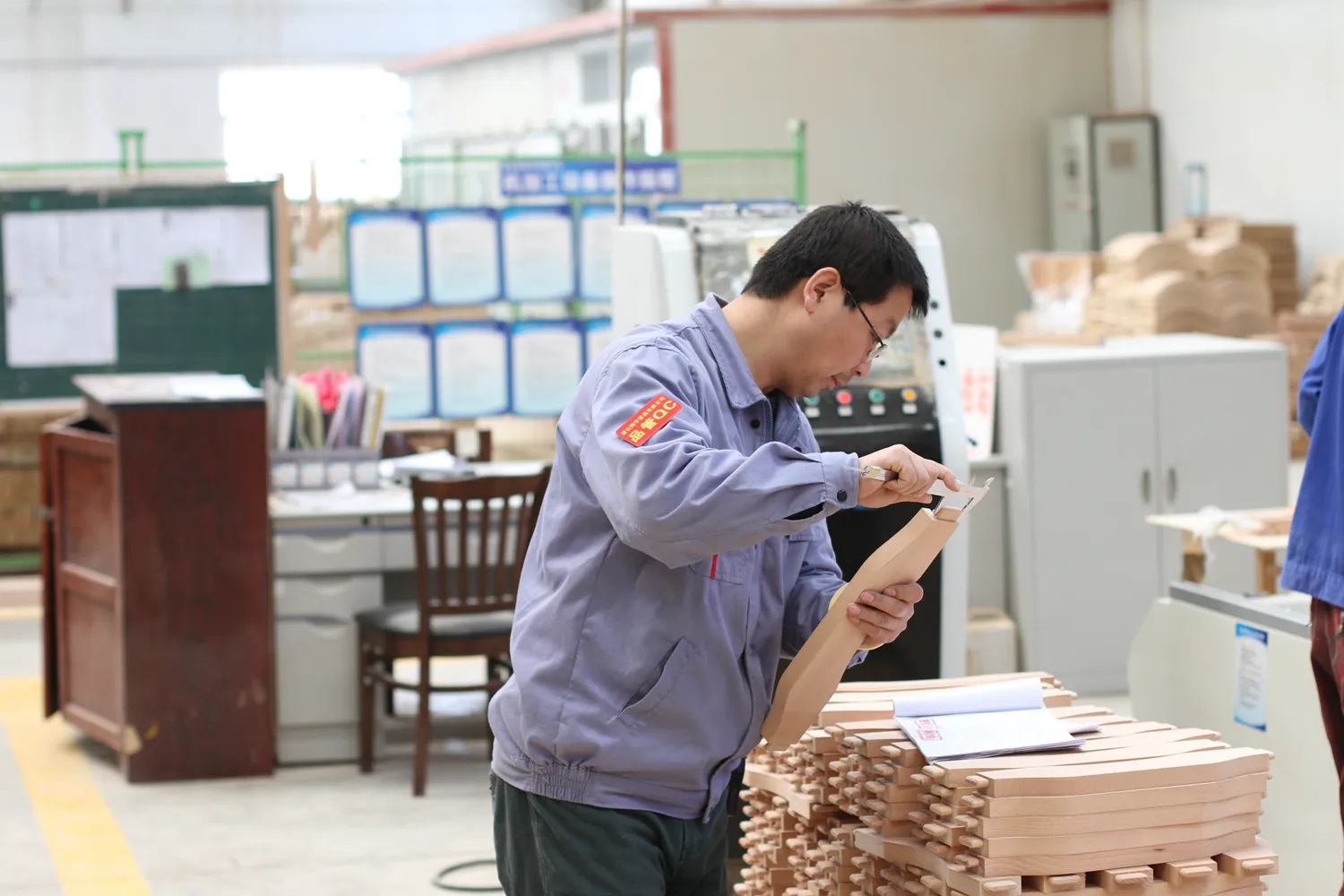
A product photograph tells you what a chair looks like. A physical sample reveals much more about how it is constructed and how it feels.
When possible, inspect an approved sample before confirming a substantial order.
Start with the basics.
Place the chair on a level surface and check whether it sits evenly. Examine the connections and look for obvious movement or poorly finished joints.
Sit in the chair and assess comfort, stability, seat height and backrest support.
Then review the details that may become problems during regular use:
- Uneven paint, coating or wood finish
- Exposed or poorly finished edges
- Loose upholstery and irregular stitching
- Inconsistent dimensions
- Damaged or unsuitable floor glides
- Differences between the sample and approved drawings
For restaurant dining chairs with mixed wood, metal and upholstery construction, pay particular attention to how the materials connect.
A chair can use good materials yet still perform poorly if the connections and assembly are not properly executed.
A sample inspection does not establish long-term performance on its own. If the project requires particular structural or durability testing, those requirements should be agreed upon separately.
The Hidden Cost of Replacing Chairs Too Frequently
When comparing quotations, buyers often focus on the initial unit price.
However, the lowest purchase price may not produce the lowest cost over the furniture’s useful life.
Suppose a restaurant chooses a less expensive chair but needs to replace a significant number of pieces earlier than expected.
The true expense may involve more than buying replacement furniture. It can also include freight, receiving, storage, installation and the difficulty of matching older finishes.
This is especially relevant for restaurant chains that need consistent seating across several locations.
The right comparison is not simply:
Which chair costs less today?
It is also:
Which chair meets the restaurant’s requirements with fewer avoidable replacement and maintenance problems?
Reliable specifications, suitable materials and a supplier capable of supporting repeat orders can be more valuable than a small reduction in the original quotation.
Build Better Chair Specifications Before Production
The most practical way to reduce furniture problems is to define the requirements before production starts.
For a restaurant project, a purchasing specification should cover the important details that affect appearance, fit and construction.
These may include:
- Approved chair model and overall dimensions
- Frame and structural materials
- Wood stain or metal finish reference
- Upholstery material and color reference
- Seat construction and cushioning requirements
- Floor glide type
- Approved sample or drawing reference
- Packaging and delivery requirements
If the project involves customization, changes should be confirmed in writing before bulk production.
At TSXY, restaurant seating projects can be discussed according to the required dimensions, materials, upholstery and finishes through our Custom Furniture Solutions service.
The objective is to make sure that the product approved during selection is clearly defined for production.
Choose Chairs for the Restaurant You Actually Operate
The best restaurant dining chairs are not necessarily the most expensive or the most visually distinctive.
They are the chairs that suit the restaurant’s layout, customer experience, cleaning routine and operational demands.
For a small café, easy movement and compact dimensions may matter most. For a full-service restaurant, seat comfort and finish consistency may deserve greater attention. For a growing chain, repeat-order availability and clear specifications become increasingly important.
Before buying, look closely at frame connections, upholstery construction, dimensions and finish details. Review representative samples and document the final specifications.
Explore TSXY’s restaurant furniture collection to compare dining seating and other commercial furniture options for your next project.